Reverb plugins
15 plugins, sourced from developer spec pages and cross-checked where needed. This is a spec-based comparison, not a set of hands-on reviews.

1Pro-R 2
FabFilter
Feature-loaded hybrid reverb. Frequency-specific decay control, built for detailed mix work.
- Decay Rate EQ lets you tame low-end buildup or extend air separately, so you can shape the reverb's tone without reaching for a separate EQ afterward
- Covers Dolby Atmos up to 9.1.6, useful if you ever need to deliver an immersive mix without hunting down a separate plugin
- Freeze turns any moment into a held pad on demand, handy for sound design as well as normal reverb duty
- At $199 it's a serious investment for a single reverb plugin, worth it mainly if you'll actually use its deeper frequency-specific controls
- The deep parameter set takes longer to learn than a simple one-knob reverb, overkill if you just want a quick send

2Blackhole
Eventide
Ambient-leaning algorithmic reverb. Built for otherworldly textures, not tidy rooms.
- Gravity reverses the decay curve for a swelling, bloom-like tail that's genuinely hard to get from a conventional reverb
- Cloud-based iLok means no physical dongle to lose, one less thing to manage on a laptop rig
- Artist presets from Richard Devine and Flood are a fast route into sounds that would take hours to dial in from scratch
- It's built for ambient and sound-design textures, so it's a weaker pick if what you actually need is a believable small room or plate
- 50-odd presets is on the thin side if you're used to libraries that ship hundreds, you'll be building your own sooner

3Rev PLATE-140
Arturia
Single-purpose plate reverb. Models the EMT 140, tube warmth built in.
- Built-in tube preamp and chorus mean you often don't need extra plugins to get a finished vintage-plate sound
- NKS support makes it quick to dial in from Native Instruments hardware if that's already part of your rig
- Three plate character options give some range without leaving the plate-reverb lane
- It only does plate reverb, so it's a poor fit if you also need rooms or halls, you'll be buying a second plugin either way
- At $85 for a single-purpose plate reverb, it's a meaningful spend if plate is the only character you'll ever need from it
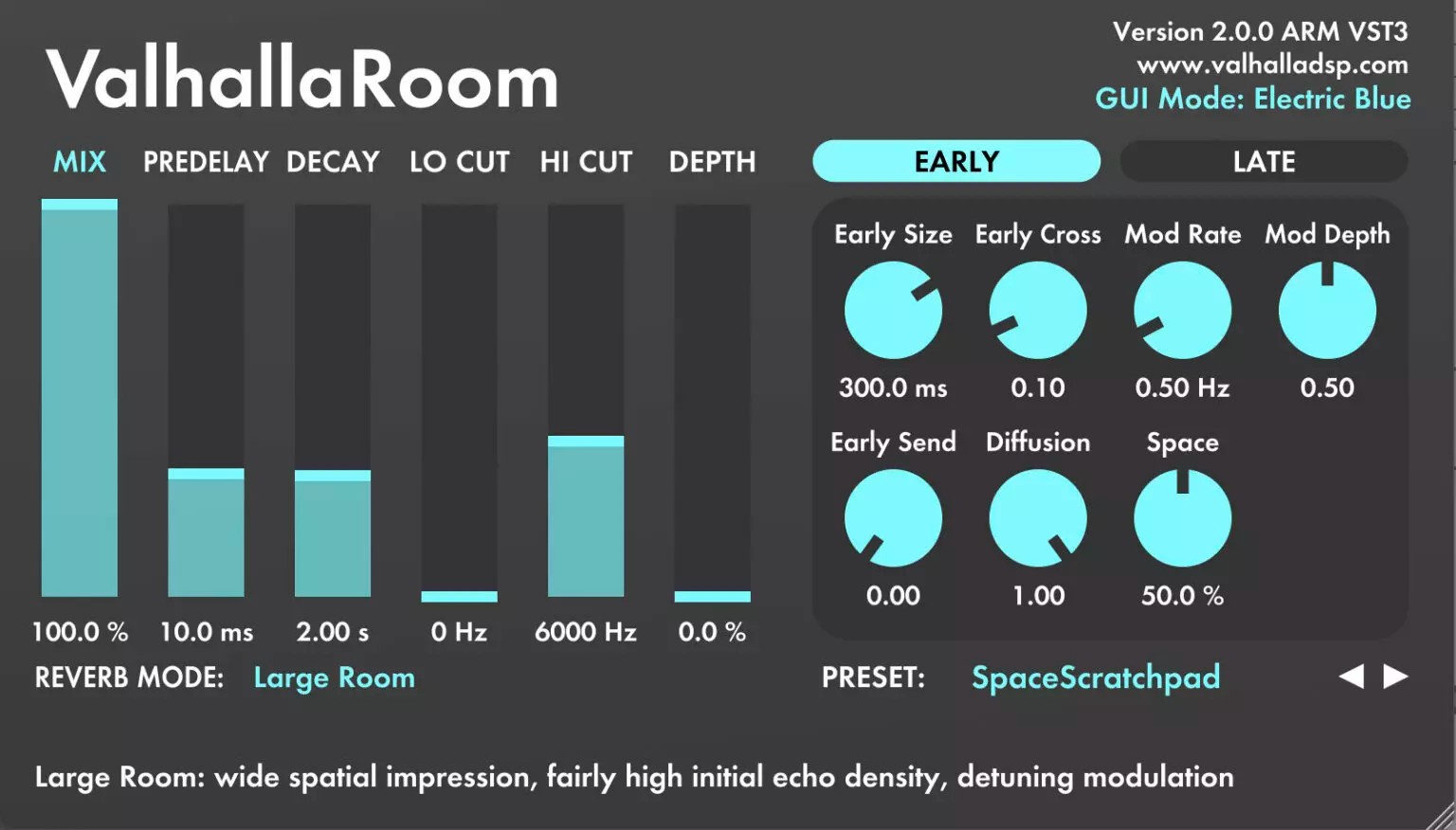
Room
Valhalla DSP
Natural-sounding algorithmic reverb. Twelve room, chamber, and space algorithms, tuned for clean, believable spaces.
- Twelve dedicated algorithms span rooms, chambers, and four sci-fi-styled space modes, real range for both natural and unnatural spaces from one plugin
- True stereo processing carries through both the early reflections and the late reverb tail, so a wide stereo source keeps its width going into and out of the reverb
- A 3-band frequency control on the decay plus a dedicated Space knob for early-reflection balance give real tonal shaping at a $50 price point
- Every algorithm here is synthesized rather than sampled from a real space, so a project that specifically needs a convolution capture of one physical room or hall calls for a different kind of reverb
- VST2, VST3, AU, and AAX are covered, but there is no CLAP support, a gap for anyone standardizing a session around CLAP-only plugins

VintageVerb
Valhalla DSP
Budget algorithmic reverb. Three decades of character, one plugin.
- 22 algorithms across three eras means a wide range of vintage character in one plugin, not just one flavor
- At $50 it's an accessible price point, and it still covers Windows, macOS, and every major plugin format
- The deliberately imperfect vintage modes give a mix real character that a pristine, ultra-clean reverb doesn't have
- Purely algorithmic, so if you need an exact capture of a real room, this isn't the tool, that's convolution territory
- No documented maximum decay time, so pushing it to extremes is more guesswork than the spec sheet gives you

Altiverb 8
Audio Ease
Premium convolution reverb. Real recorded spaces, built for post and high-end scoring work.
- Hundreds of real impulse responses from actual halls and rooms mean you're placing a sound in a real space, not an approximation of one
- Stage Positioning lets you place individual sources within a captured venue, a level of realism convolution alone doesn't usually offer
- IRTool lets you capture and add your own spaces, so the library keeps growing on your terms
- At $520 it's a serious investment, this is a professional post-production and scoring tool, not an impulse buy for a home studio
- Atmos and 9.1.6 support is locked to the pricier XL version, so the base plugin doesn't get you the full immersive picture

BigSky Plugin
Strymon
Twelve reverb machines from Strymon's pedal. Ported straight to your DAW.
- 12 distinct reverb machines in one plugin covers spring, plate, hall, shimmer and more, reducing how many single-purpose reverbs you need to own
- Infinite Sustain/Freeze holds a tail indefinitely, a sound-design trick that's awkward to fake with most reverbs
- It's a direct port of a well-known hardware pedal, so the algorithms already have years of real-world use behind them
- At $199, it's a premium price point, though you're getting twelve distinct reverb engines in exchange
- An 8GB RAM minimum is a notably heavy system requirement for a reverb plugin

Crystalline
Baby Audio
Modern algorithmic reverb. Automatic ducking, a huge preset library.
- Ducker automatically pulls the reverb back whenever the dry signal plays, a mix trick you'd otherwise have to automate by hand
- 300+ presets from named producers means you're rarely starting from a blank slate
- Eco Mode keeps CPU load down, useful if you're already loading a session with heavier plugins
- It's built around one algorithm (allpass-loop), so it won't give you the range of a multi-engine reverb
- At $99, it's worth checking the demo matches what you actually need before buying, since you're committing to that one algorithm's character

FlexVerb
Solid State Logic
All-in-one SSL reverb. Built-in EQ and compression, not just a space.
- Early and late reflections can be sourced from different algorithms, so you can mix one room's attack with another's tail
- The built-in 6-band SSL EQ and sidechain-responsive compressor mean you can shape the reverb without reaching for extra plugins
- Three-band decay multipliers give frequency-specific control most single-knob reverbs don't offer
- True stereo handling isn't documented on the product page, worth confirming directly if that matters for your work
- Bundling EQ and compression into the reverb makes it a heavier, more opinionated tool if all you want is a simple space

Neoverb
iZotope
AI-assisted reverb. Blends three reverb types, reacts to your mix in real time.
- Reverb Assistant configures a starting point from your actual input, useful when you don't know where to start
- Blend Pad mixes three reverb types at once, so you're not forced to commit to a single character
- Masking Meter talks to other iZotope plugins to flag when the reverb is fighting other tracks for space, catching problems a static reverb can't
- It leans on iZotope's ecosystem and the Exponential Audio engine rather than one signature sound, so it can feel less distinctive than a dedicated single-algorithm reverb
- The assistant-driven workflow is a different way of working than turning knobs by hand, which won't suit everyone

Seventh Heaven
LiquidSonics
Hybrid reverb built on real hardware captures. Tunable like an algorithmic engine.
- Fusion-IR blends a real hardware capture with algorithmic control, so you get authenticity without losing tweakability
- Silence detection auto-bypasses processing when there's nothing to reverberate, a small but genuinely useful CPU saver
- At $69 it's an accessible price for a reverb built on real hardware captures rather than a fully synthetic algorithm
- Decay tops out at 30 seconds, noticeably short if you're after huge, endless ambient tails
- It's tied to the specific M7 hardware character, so it's less of a blank-slate tool than a fully generic room/hall reverb

smart:reverb 2
sonible
AI-driven reverb. Analyzes your track, builds a response around it.
- Analyzes your actual input and builds a tailored response, rather than making you dial in a generic preset by hand
- Cross-channel processing helps multiple reverb instances avoid masking each other, a mix problem most reverbs leave entirely to you
- Perception-based controls (Size, Width, Distance) are more intuitive for newer users than raw decay and pre-delay numbers
- The AI-driven approach means less direct manual control than a traditional parametric reverb, which can frustrate engineers who like to dial things in by ear
- At $129, it's a premium price for an algorithmic reverb, worth it mainly if you'll actually lean on the AI-assisted workflow

SP2016 Reverb
Eventide
Hardware-accurate reverb reissue. Three algorithms, built for engineers who know the original.
- Faithfully carries over the original 1982 hardware's sound, including a genuine Vintage mode, not just a modern plugin dressed up to look retro
- Position control repositions the reverb in the mix without touching decay or tone, a genuinely different workflow shortcut
- Artist presets from Dave Pensado and George Massenburg are a quick way to hear what pros actually dial in
- Only three core algorithms, so if you want a dozen-plus options to explore, this will feel narrow
- Requires iLok account authorization, an extra step some engineers would rather skip

Supermassive
Valhalla DSP
Free hybrid delay-reverb. Twenty-two modes, built for wash and texture.
- It's completely free, which makes it an easy way to try a hybrid delay-reverb with zero commitment
- WARP can turn a simple echo into a dense, washed-out reverb on the fly, blurring the line between delay and reverb creatively
- Doubles as a tempo-synced delay, so it can fill two roles in a session instead of one
- It's a hybrid delay/reverb device rather than a dedicated room or plate reverb, so it's a poor substitute if you need a precise, natural space
- Several modes don't state a hard decay limit, so tail behavior at extremes is somewhat unpredictable

SuperPlate
Soundtoys
Five vintage plate reverbs in one plugin. Built for vocals and snares.
- Five distinct plate models cover a real range of vintage character, not just one generic plate emulation dressed up five ways
- Auto-Decay ducking automatically manages overlap as you change decay time, one less thing to ride manually
- The bundled Little Plate gives you a lighter, quicker version for when the full plugin is more than you need
- It only covers plate reverb, so you'll still need something else for rooms, halls, or convolution work
- Not compatible with ARM-based Windows machines, worth checking if that's your setup